

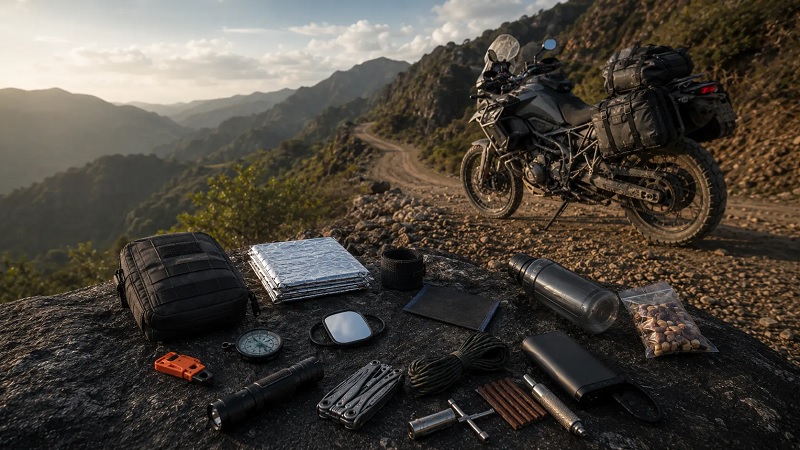
Riding a motorcycle exposes you to the raw elements of the road. There is no metal cage, no crumple zone, and no airbag to insulate you from the physics of a sudden stop. While the core tenets of motorcycle safety—a DOT-approved helmet, a reinforced jacket, armored pants, gloves, and sturdy boots—are universally understood, surviving a ride is only half the equation. The other half is proactively preventing an incident before it ever occurs.
This proactive approach requires outfitting yourself and your machine with specific accessories designed to enhance your visibility, maintain your physical dexterity, and sharpen your situational awareness. Beyond the standard protective gear, integrating the right tactical accessories into your daily riding routine transforms a vulnerable commute into a highly controlled, predictable journey. By eliminating environmental distractions and mechanical vulnerabilities, you can maintain the razor-sharp focus required to navigate modern traffic.
Advanced Vision and Visibility Enhancements
A rider who cannot see the road, or a rider who is invisible to surrounding traffic, is in immediate danger. Vision is the primary sensory input for motorcycling, and it must be protected against weather, glare, and darkness. A compromised line of sight drastically reduces the time you have to react to sudden hazards.
Anti-Fog Pinlock Inserts
Riding in cold or damp conditions almost guarantees that your warm breath will condense on the cold interior of your helmet visor. A fogged visor forces a rider to crack the shield open, letting in freezing air, rain, and stinging road debris, which severely distracts from the task of driving. Pinlock inserts solve this problem permanently. These flexible shields attach to the inside of a compatible visor, creating a sealed, dual-pane thermal barrier. This trapped pocket of air prevents condensation from forming, ensuring crystal-clear vision regardless of the ambient temperature or humidity. It is a simple, passive accessory that completely eliminates a massive environmental hazard, allowing you to keep your visor snapped shut and your eyes locked on the horizon.
Auxiliary LED Lighting Systems
Most factory motorcycle headlights are engineered to meet minimum legal requirements, which often translates to a narrow, dim beam that struggles to pierce the darkness of a rural highway. More importantly, a single headlight makes it incredibly difficult for oncoming drivers to accurately judge a motorcycle’s distance and approach speed. Installing auxiliary LED driving lights mounted low on the engine guards or front forks creates a distinctive, wide triangle of light. This wider footprint not only illuminates the shoulders of the road—highlighting hidden wildlife or gravel patches before you reach them—but also breaks up the background visual clutter. A triangular light pattern makes your vehicle instantly recognizable to distracted motorists, forcing them to register your presence on the asphalt.
Auditory Protection and Situational Awareness
The roar of a motorcycle engine is an iconic part of the experience, but the true threat to a rider’s hearing and cognitive focus is wind noise. At highway speeds, the turbulent air rushing over the contours of a helmet can easily exceed one hundred decibels, causing immediate damage and severe fatigue.
High-Fidelity Motorcycle Earplugs
Prolonged exposure to highway wind noise causes irreversible hearing damage and induces profound physical exhaustion. A fatigued rider suffers from delayed reaction times, poor decision-making, and reduced environmental awareness. While traditional foam earplugs block out the wind, they also muffle critical ambient sounds, such as ambulance sirens, screeching tires, or the sound of another vehicle sitting in your blind spot. High-fidelity motorcycle earplugs are engineered with internal acoustic filters that specifically target and dampen the damaging high-frequency roar of the wind. Simultaneously, they allow lower-frequency noises to pass through clearly. Preserving your hearing directly preserves your spatial awareness, keeping you connected to the traffic flowing around you.
Helmet Communication Systems
Taking your eyes off the road for even two seconds at sixty miles per hour means you have traveled blindly for over a hundred and seventy feet. Looking down at a phone strapped to your handlebars to check GPS directions is a highly dangerous, yet incredibly common, habit. Integrating a Bluetooth communication system into your helmet allows you to receive turn-by-turn navigation instructions through internal speakers. Keeping your visual focus locked entirely on the horizon and the vehicles ahead of you drastically reduces the likelihood of a rear-end collision or a missed road hazard.
Tactical Comfort and Machine Control
Operating a motorcycle requires fine motor skills. Your hands and lower body must execute precise inputs to steer, brake, and accelerate smoothly. When physical discomfort sets in, vehicle control rapidly deteriorates, turning a capable rider into a rigid passenger.
Heated Grips and Thermoregulated Gear
When riding in cold weather, the human body naturally pulls warm blood away from the extremities to protect the vital organs in your core. Numb, freezing fingers simply cannot smoothly modulate a front brake lever or accurately feather a clutch. This lack of tactile feedback easily leads to grabbing too much brake and locking the front wheel during a panic stop. Heated grips and battery-powered heated gloves are not luxury items; they are essential safety equipment. By keeping the hands warm, pliable, and responsive, a rider maintains the delicate muscle control required to execute emergency evasive maneuvers safely and effectively.
Tank Grips and Stomp Pads
Proper riding technique dictates that a rider should grip the motorcycle heavily with their knees and lower body, leaving the arms and hands loose and relaxed on the handlebars. However, aggressive braking pushes the rider’s weight violently forward, causing them to slide up against the slick paint of the gas tank. To prevent this, riders instinctively stiffen their arms against the bars, which instantly destabilizes the steering geometry. Applying textured tank grips to the sides of the motorcycle provides a high-friction surface for your knees to lock into. This anchors your lower body during heavy braking and sharp cornering, completely isolating your steering inputs from your body weight and keeping the motorcycle chassis perfectly stable under stress.
Emergency Preparedness and Recovery
No matter how defensive your daily riding strategy is, mechanical failures and unpredictable road debris are inevitable realities. Being stranded on the narrow shoulder of a busy interstate or a blind mountain curve leaves a rider highly vulnerable to passing traffic.
Compact Tire Repair and Inflation Kits
A blowout on a two-wheeled vehicle is a terrifying experience, but the danger certainly does not end once you safely pull the bike over. Waiting hours for a tow truck on the side of a highway is a massive physical liability. Carrying a compact tire plug kit and a portable 12-volt air compressor allows you to repair a tubeless tire puncture and reinflate the tire in a matter of minutes. Getting the motorcycle back in motion and safely off the side of the road is a critical safety priority that relies entirely on your own preparedness.
Motorcycle-Specific Trauma Kits
A standard first aid kit filled with small adhesive bandages and antiseptic wipes is entirely insufficient for the realities of a motorcycle crash. A proper riding medical kit must focus on managing major trauma. Packing a compact, easily accessible kit that includes a tourniquet, hemostatic gauze, and a pressure dressing can literally save a life in the critical minutes before professional emergency medical services manage to arrive on the scene.
Smart Technology and Crash Detection
When a rider goes down on a deserted canyon road or a dark rural route, the inability to call for help compounds the danger of the initial impact. If the rider is physically incapacitated, thrown into a ditch, or separated from their mobile phone, the situation becomes critical.
Installing a GPS-enabled crash detection tracker provides a silent, automated digital safety net. These discrete modules wire directly into the motorcycle’s battery and utilize advanced internal accelerometers and gyroscopes to monitor the bike’s behavior. They are calibrated to detect the sudden deceleration, violent impact, and severe lean angles associated with a crash. If the system detects an accident and the bike does not upright itself within a specific timeframe, it automatically transmits an emergency SOS signal. This signal sends your exact GPS coordinates to designated emergency contacts or local emergency dispatchers, ensuring that help is dispatched immediately, even if you are unconscious.
Safety on a motorcycle is a dynamic, ongoing process that requires constant vigilance. It extends far beyond the passive protection of a heavy leather jacket or an armored carbon fiber helmet. By intentionally outfitting your gear and your machine with accessories that enhance your field of vision, protect your physical stamina, and prepare you for mechanical emergencies, you actively strip away the unpredictable variables of the road. True riding safety is achieved when you command the environment rather than merely reacting to it, ensuring that every time you twist the throttle, you are fully equipped for the journey ahead.

Comments are closed.